

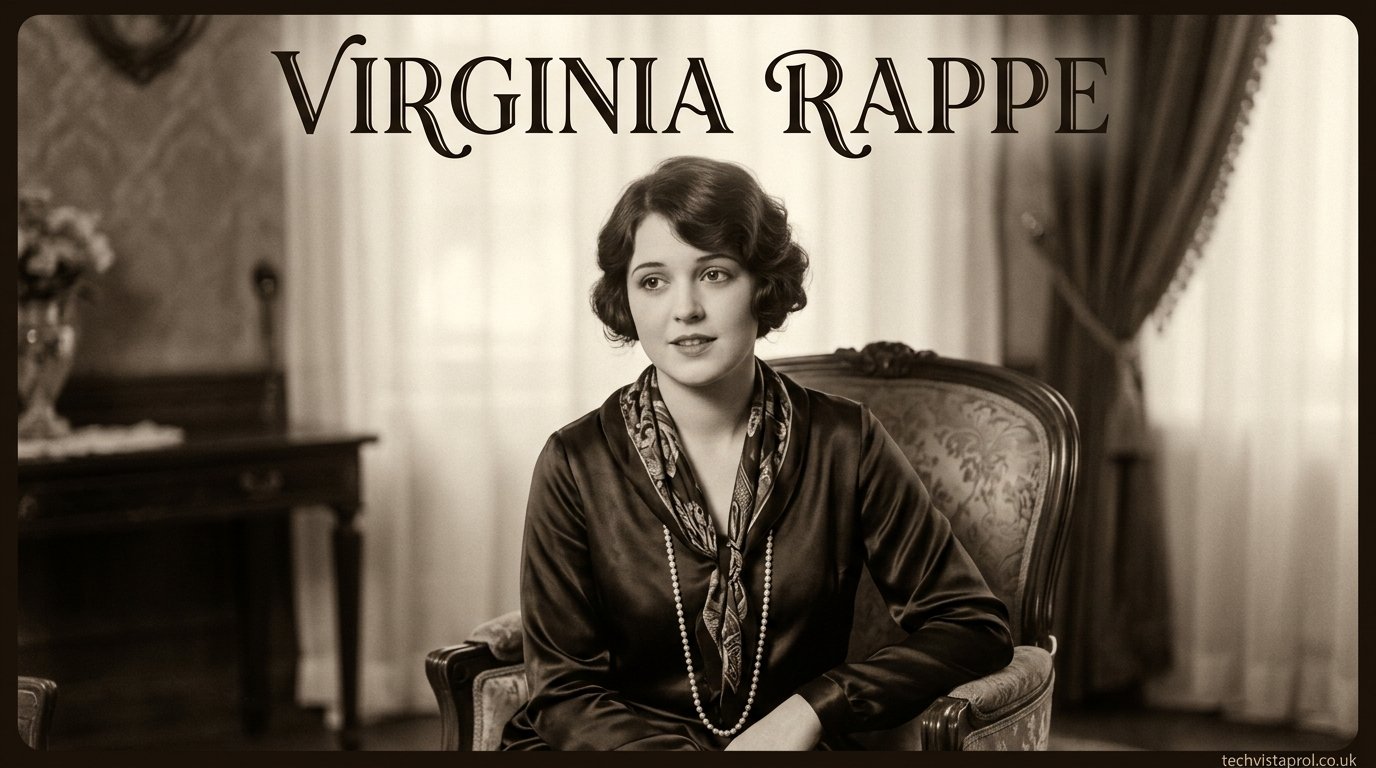
Who Was Virginia Rappe?
Virginia Rappe was an American model and silent film actress whose name became permanently linked to one of the earliest and most damaging scandals in Hollywood history. Born Zelliene Virginia Rappe on July 7, 1891, in Chicago, Illinois, she built a modest but genuine career in front of the camera during the late 1910s before her sudden death in September 1921 turned her into a household name for tragic reasons. Most people today recognize her not for her work as an actress but for her connection to comedian Roscoe “Fatty” Arbuckle, whose career was destroyed after she fell fatally ill at a party he hosted.
Understanding Virginia Rappe as a real person, rather than simply a footnote in someone else’s trial, is important for getting an accurate picture of early Hollywood. She was an aspiring actress, a working model, and a young woman trying to build a life in a new and rapidly growing entertainment industry. The sensational headlines that followed her death often overshadowed the facts of who she actually was, and separating fact from rumor is essential to understanding her story with the depth and accuracy it deserves.
This article looks closely at her life, her short career in silent film, the circumstances surrounding her death, and the long shadow that the resulting scandal cast over the entire American film industry. It draws on historical records, court testimony, and modern biographical research to present a balanced account rather than repeating the exaggerated tabloid narratives that have followed her name for over a century.
Early Life and Background
Virginia Rappe had a difficult childhood that shaped much of her early independence. She was born to a young, unmarried mother, Mabel Rappe, and never knew her father. Her mother died when Virginia was only eleven years old, leaving her to be raised by her grandmother. This early loss meant that Rappe grew up without the stability many of her peers had, and she began supporting herself at a young age, first finding work as a commercial and artist’s model by her mid-teens.
By her late teens, Rappe had relocated to San Francisco to pursue modeling more seriously, eventually working her way into fashion design and costume work. She experienced personal heartbreak early on as well, including an engagement to a dress designer who was killed in a streetcar accident before they could marry. These hardships did not stop her ambition. She moved to Los Angeles in search of opportunities in the growing film industry, a decision that would eventually lead to both a career and, tragically, the events that ended her life.
Some accounts of Rappe’s youth describe a turbulent and difficult adolescence, including early pregnancies and the loss of a child she placed into foster care years before her death. These details were later used against her by Arbuckle’s defense team during his trials, but they also reveal a young woman who faced enormous personal hardship long before she ever set foot in a Hollywood studio. Far from the sheltered ingenue she was sometimes portrayed as in the press, Rappe was someone who had already survived significant trauma and instability by the time she became a public figure.
Her Career in Silent Films
Contrary to the popular image of Virginia Rappe as merely a party guest with no real career, she had genuine acting credits to her name. In 1917, she landed a notable role in the silent film “Paradise Garden,” opposite established star Harold Lockwood. This was a meaningful break for a young actress trying to establish herself in a competitive industry, and it placed her name on movie posters and in trade publications of the era.
Rappe went on to appear in additional films throughout the late 1910s, often in supporting roles within comedy shorts produced for studios competing with the larger Keystone operation. She became romantically involved with director Henry Lehrman, a contemporary of Arbuckle who had also worked at Keystone Studios, and the two were engaged to be married at the time of her death. Her work was modest compared to the biggest stars of the silent era, but she was a working actress with real ambitions, not merely a background figure in Hollywood social circles.
Beyond acting, Rappe was also known within the fashion world for her work as a clothing designer, and she had ambitions to combine her interest in design with her film career. This professional context matters because later media coverage often stripped away her identity as an actress and businesswoman, reducing her to a single tragic incident at a party she did not organize and barely knew the host of. Remembering her career accurately helps restore some of the dignity that sensational reporting took from her in the months following her death.
The Fateful Labor Day Party at the St. Francis Hotel
On September 5, 1921, Labor Day, Roscoe Arbuckle traveled to San Francisco with two friends and checked into a suite of rooms at the St. Francis Hotel. What began as a gathering with bootleg alcohol, common during the era of Prohibition, turned into a larger party as more guests arrived throughout the day. Virginia Rappe attended along with Bambina Maude Delmont, a woman she had only recently met and who would later become the central accuser in the criminal case against Arbuckle.
At some point during the party, Rappe became severely ill. Witnesses described her crying out in pain, and a hotel physician was called to examine her. The doctor initially believed her symptoms stemmed from intoxication and administered morphine to calm her. The exact sequence of events inside the hotel room remains disputed to this day, with different witnesses offering conflicting accounts, some implicating Arbuckle directly and others suggesting her collapse had medical causes unrelated to any assault.
Accounts from that day describe a chaotic scene, with multiple guests moving between rooms, alcohol flowing freely despite Prohibition laws, and confusion about who actually witnessed the critical moments before Rappe’s collapse. Some guests later testified that she was found in distress in a bathroom and was helped to a bed, while others gave dramatically different versions involving screaming and torn clothing. This inconsistency among witnesses became one of the central challenges for prosecutors and defense attorneys alike, and it remains a key reason why the true events of that afternoon have never been definitively established.
Virginia Rappe’s Death and Its Immediate Aftermath
Virginia Rappe did not recover from her illness at the party. She was moved to a hospital, where her condition worsened over the following days. She died on September 9, 1921, four days after the gathering, from a ruptured bladder and the resulting peritonitis, a severe and often fatal abdominal infection. Her death set off a chain of events that would dominate national headlines for months and effectively end Roscoe Arbuckle’s career as one of the highest-paid entertainers in America.
Maude Delmont went to authorities and accused Arbuckle of sexually assaulting Rappe, claiming the assault caused her fatal injuries. San Francisco’s district attorney, eager to pursue the case aggressively, charged Arbuckle first with manslaughter and later sought an even more serious charge. The speed and intensity of the legal response reflected both the genuine uncertainty around what had happened and the political pressures of a district attorney determined to make an example of a wealthy celebrity during an era of growing public concern about Hollywood excess.
News of Rappe’s death spread quickly across the country, and Arbuckle was arrested within a day of her passing. The arrest itself became front-page news nationwide, with reporters camped outside the jail and courthouse for weeks. For a public already wary of the perceived moral decline associated with the movie industry, the case offered a dramatic and easily digestible story of celebrity excess, and newspapers wasted little time turning Virginia Rappe’s death into a national sensation rather than treating it as the private tragedy it was for her family and friends.
The Arbuckle Trials and the Search for Truth
Roscoe Arbuckle faced not one but three trials in connection with Virginia Rappe’s death. The first two trials ended in hung juries, with jurors unable to agree on his guilt or innocence based on the available evidence. Witness testimony was often inconsistent, and Delmont, the original accuser, had a documented history involving extortion and fraud, which damaged her credibility as the case progressed and kept her off the witness stand in later trials.
The third trial concluded with a full acquittal, and in an unusual move, the jury issued a written statement expressing regret over the ordeal Arbuckle had endured, stating that no real evidence connected him to a crime. Medical testimony presented during the trials suggested that Rappe had a preexisting condition, cystitis, that could have been aggravated by alcohol consumption and physical strain, offering an alternative explanation for her injuries that did not require an assault to have occurred. Despite this formal vindication, the damage to Arbuckle’s reputation and career had already been done, and the public never fully separated him from the scandal regardless of the verdict.
Media Sensationalism and the Smearing of Virginia Rappe’s Reputation
One of the most troubling aspects of the Virginia Rappe case is how thoroughly the media exploited her death for profit. Newspaper chains of the era, particularly those controlled by William Randolph Hearst, ran exaggerated and often fabricated stories about the party, the assault allegations, and the people involved. The coverage was so aggressive that Hearst himself reportedly remarked that the scandal had sold more newspapers than the sinking of the Lusitania, a comment that reveals just how much the tragedy was treated as entertainment rather than a serious human loss.
As the trials unfolded, Arbuckle’s defense strategy increasingly relied on portraying Rappe in a negative light, raising details about her personal life and medical history in an effort to suggest that her death resulted from preexisting conditions rather than any assault. At the same time, prosecutors and sympathetic press painted her as an innocent victim destroyed by a predatory celebrity. Caught between these two extremes, the real Virginia Rappe, a working actress with her own ambitions and struggles, was largely erased from her own story. Modern researchers and biographers have worked to correct this imbalance, presenting a more nuanced and human portrait of who she actually was.
Virginia Rappe’s Legacy in Hollywood History
More than a century later, Virginia Rappe remains a significant figure in the history of early Hollywood, not because of any film role but because her death triggered some of the industry’s first major efforts at self-regulation. The scandal contributed directly to the creation of the Hays Office, an early version of Hollywood’s film censorship and morality code, as studios scrambled to protect their public image following the controversy. In this sense, her story had a lasting structural impact on how the American film industry operated for decades afterward.
Virginia Rappe is buried at Hollywood Forever Cemetery in Los Angeles, not far from many of the era’s biggest stars, a quiet resting place for someone whose life was overshadowed by a scandal she did not live to see resolved. Biographers and historians researching the Arbuckle case, most notably Greg Merritt in his well-regarded book on the subject, have worked to give Rappe a fuller identity beyond the headlines, documenting her career, her relationships, and the hardships she faced from childhood onward. This ongoing historical interest shows that her story continues to resonate as both a true crime mystery and a case study in media ethics.
Lessons from the Virginia Rappe Story
The story of Virginia Rappe offers important lessons about how the media handles tragedy, particularly when public figures and sensational headlines are involved. Her case demonstrates how easily a real person can be reduced to a symbol, whether as a saintly victim or a vilified troublemaker, depending on which narrative best serves the interests of those telling the story. For anyone researching historical true crime cases, her story is a reminder to look beyond the dominant headlines of the time and seek out primary sources, court records, and balanced modern scholarship.
Her case also remains relevant to ongoing conversations about how legal systems and public opinion treat both accusers and the accused in high-profile cases, especially when the alleged victim cannot speak for themselves. The uncertainty that still surrounds the exact events of September 5, 1921, serves as a caution against rushing to firm conclusions based on incomplete or motivated reporting. Virginia Rappe’s life, both before and after that fateful Labor Day party, deserves to be remembered with accuracy and respect rather than reduced to a single contested night in a San Francisco hotel room.
