

Introduction
James Maynard Keenan is widely regarded as one of the most influential and enigmatic figures in modern rock music. Born James Herbert Keenan on April 17, 1964, in Ravenna, Ohio, he is best known as the lead vocalist and lyricist for the Grammy-winning band Tool, as well as the co-founder of A Perfect Circle and the creative force behind Puscifer. His career spans more than three decades, blending progressive metal, alternative rock, experimental sound design, and conceptual performance art into a distinctive artistic identity.
Across his musical journey, Keenan has built a reputation for intellectual lyricism, emotional depth, and strict artistic discipline. Rather than following mainstream expectations, he has consistently chosen creative independence, making him a defining figure in alternative and progressive music culture. His influence extends beyond music into winemaking, entrepreneurship, and performance art, reflecting a multifaceted creative philosophy.
Early Life, Military Service, and Creative Formation
James Keenan’s early life was shaped by frequent relocation between Ohio and Michigan, where he developed a strong sense of independence and observation. These formative experiences contributed to the introspective themes that would later define his songwriting. Growing up outside traditional artistic hubs gave him a grounded perspective that contrasted sharply with the surreal and philosophical nature of his later work.
After graduating high school, Keenan enlisted in the United States Army, an experience that added discipline and structure to his worldview. This period of service is often referenced as influential in shaping his approach to focus, endurance, and psychological resilience. Following his military career, he transitioned toward creative pursuits, eventually studying art and beginning to explore music more seriously. This combination of discipline and introspection became a foundation for his later artistic identity.
The Rise of Tool and the Birth of a Progressive Metal Revolution
Tool was formed in the early 1990s and quickly became one of the most groundbreaking bands in alternative metal and progressive rock. With albums like Undertow, Ænima, Lateralus, and 10,000 Days, the band developed a reputation for complex compositions, unusual time signatures, and deeply philosophical lyrics. Keenan’s voice became central to the band’s identity, shifting between controlled minimalism and explosive emotional intensity.
Tool’s music often explores psychological transformation, human consciousness, and existential struggle. Keenan’s lyrical approach avoids straightforward storytelling, instead using symbolism and metaphor to encourage interpretation. This artistic ambiguity became one of Tool’s defining characteristics, allowing listeners to engage with the music on multiple intellectual and emotional levels. The band’s long production cycles and meticulous creative process also reinforced their reputation for artistic precision over commercial speed.
A Perfect Circle and the Exploration of Emotional Contrast
In 1999, Keenan co-founded A Perfect Circle with guitarist Billy Howerdel, marking a shift toward a more melodic and emotionally accessible sound. The project allowed him to explore vulnerability, restraint, and structured songwriting in ways that contrasted with Tool’s complexity. While Howerdel focused on instrumental composition, Keenan contributed lyrics and vocal arrangements, creating a balanced creative partnership.
Albums such as Mer de Noms and Thirteenth Step established A Perfect Circle as a major force in alternative rock. The music is often described as atmospheric, emotional, and cinematic, combining orchestral elements with rock instrumentation. Through this project, Keenan demonstrated his ability to adapt his vocal identity to different emotional landscapes, reinforcing his reputation as a versatile and expressive performer.
Puscifer and the Expansion into Experimental Art
Puscifer represents Keenan’s most experimental and unconventional artistic outlet. Initially conceptualized as a creative space without strict rules, it evolved into a fully developed multimedia project blending music, satire, performance art, and conceptual storytelling. Formed in Los Angeles, Puscifer has been described as Keenan’s “creative subconscious,” allowing him to explore ideas outside traditional band structures.
Unlike Tool and A Perfect Circle, Puscifer operates with a fluid lineup, featuring collaborators such as Carina Round and Mat Mitchell. The project incorporates genres like electronic rock, trip-hop, industrial, and ambient music, creating a constantly evolving sound identity. Puscifer’s live performances often include theatrical characters, visual narratives, and comedic elements, making each show a hybrid of concert and performance art.
Musical Style, Lyricism, and Artistic Philosophy
Keenan’s artistic identity is deeply tied to thematic exploration rather than conventional songwriting. Across all his projects, he frequently addresses psychological conflict, transformation, societal critique, and personal accountability. His lyrics often avoid direct explanation, encouraging listeners to derive personal meaning from abstract imagery and layered metaphors.
Musically, his adaptability is one of his strongest traits. Tool emphasizes complexity and intensity, A Perfect Circle focuses on emotional clarity and melody, and Puscifer embraces experimentation and humor. This diversity allows him to maintain relevance across multiple musical eras while continuously evolving his artistic expression. His philosophy consistently prioritizes authenticity, self-exploration, and resistance to formulaic commercial production.
Live Performance Identity and Stage Innovation
Keenan’s approach to live performance is deliberately unconventional. In Tool concerts, he often avoids center-stage positioning, instead standing in shadows or elevated platforms to shift focus away from personality and toward the music itself. This choice reflects his belief that performance should serve the art rather than the performer.
In contrast, A Perfect Circle shows emphasize visual cohesion and emotional delivery, while Puscifer performances lean heavily into theatrical storytelling, humor, and character-driven narratives. These contrasting approaches highlight Keenan’s ability to adapt stage presence based on artistic intent rather than personal branding, reinforcing his reputation as a conceptual performer.
Winemaking, Business Ventures, and Life Beyond Music
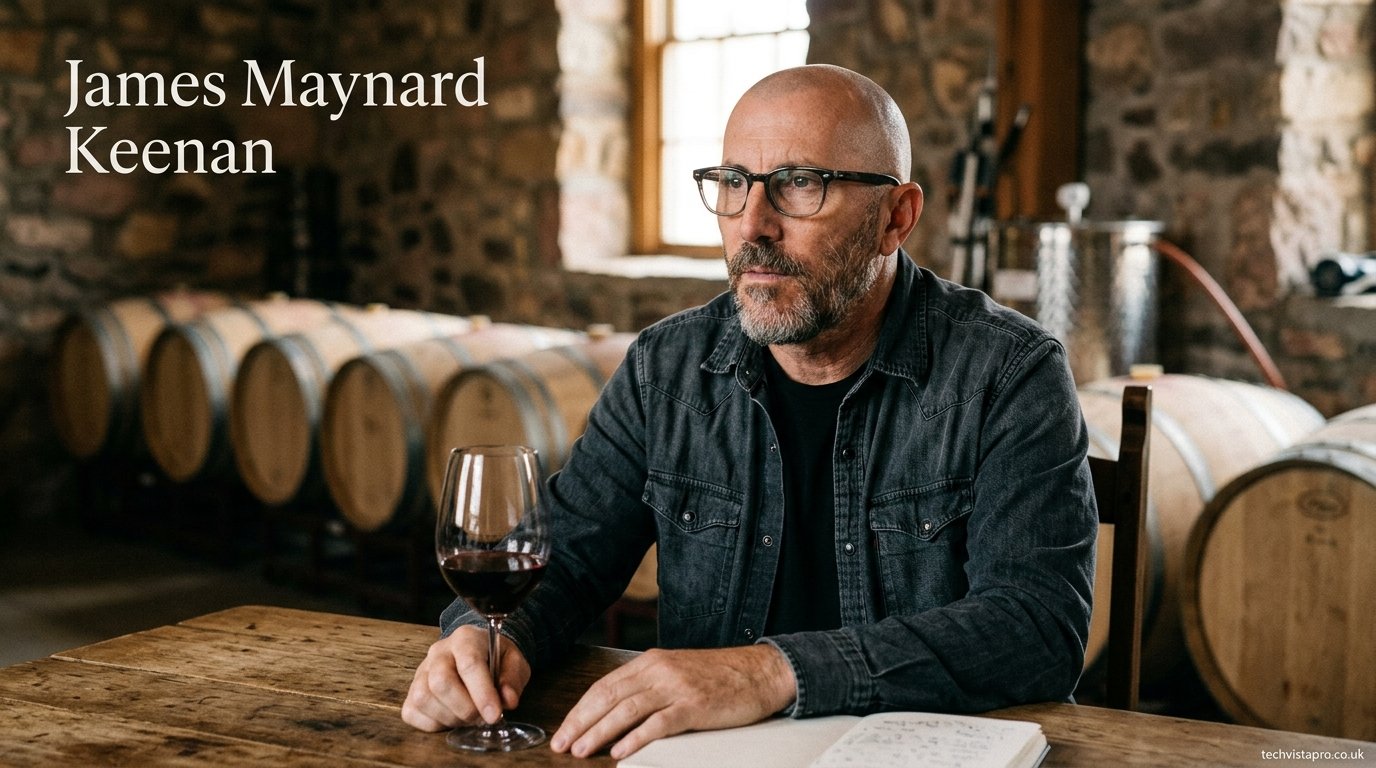
Outside of music, Keenan is also a respected winemaker and entrepreneur, operating vineyards in Arizona’s high desert region. His involvement in winemaking reflects a long-term commitment to craftsmanship, patience, and natural process-driven creativity. Unlike music production, winemaking requires seasonal cycles and environmental awareness, which aligns with his appreciation for slow, deliberate artistic development.
His business ventures also include hospitality and local community development efforts. These projects reflect his interest in sustainability and independent production outside mainstream entertainment industries. By integrating creative and agricultural pursuits, he has built a lifestyle centered on balance between artistic expression and grounded physical work.
Legacy, Cultural Influence, and Continuing Impact
James Maynard Keenan’s influence on modern music is both broad and deeply rooted. Through Tool, A Perfect Circle, and Puscifer, he has shaped multiple genres, including progressive metal, alternative rock, and experimental music. His emphasis on artistic integrity and conceptual depth has inspired countless musicians to pursue more ambitious and introspective creative paths.
His work continues to resonate with audiences due to its emotional complexity and refusal to conform to mainstream expectations. Whether through intricate compositions, emotional storytelling, or theatrical experimentation, Keenan has consistently challenged the boundaries of what rock music can be. His ongoing projects and tours continue to draw global attention, reinforcing his position as a living influence in modern music culture.
Conclusion
James Maynard Keenan stands as a rare figure in contemporary music—an artist who has successfully balanced commercial success with uncompromising creative independence. From his early life in the Midwest to his leadership of some of the most influential bands in modern rock, his journey reflects discipline, innovation, and artistic evolution.
