

The product rule in calculus is one of the most important tools used in differential mathematics to find the derivative of functions that are multiplied together. It is a foundational concept that appears early in calculus courses and continues to be used in advanced mathematics, physics, engineering, economics, and data science. Whenever two varying quantities interact in a multiplicative way, the product rule becomes necessary to understand how the result changes.
In simple terms, the product rule explains how to differentiate expressions where one function is multiplied by another function. While it may seem like you could just differentiate each part separately and multiply the results, calculus does not work that way for products. The interaction between the two functions changes the overall rate of change, and the product rule accounts for that interaction accurately. This makes it a critical concept for both academic understanding and real-world problem solving.
Meaning of Product Rule in Calculus
The product rule is a differentiation rule used when a function is written as the product of two differentiable functions. If a function is expressed as f(x) = u(x) · v(x), the product rule helps determine its derivative correctly. It ensures that the changing nature of both functions is captured simultaneously rather than independently.
In calculus, this rule is necessary because multiplication creates dependency between functions. When one function changes slightly, it affects the entire product in a way that simple differentiation cannot capture. The product rule resolves this by breaking the process into two coordinated parts that reflect how each function contributes to the overall rate of change.
From a broader mathematical perspective, the product rule is part of a group of differentiation rules that simplify complex expressions. It works alongside the chain rule and quotient rule, forming the backbone of symbolic differentiation. Without it, solving many real-world mathematical models would be significantly more difficult and less accurate.
Mathematical Formula and Core Concept
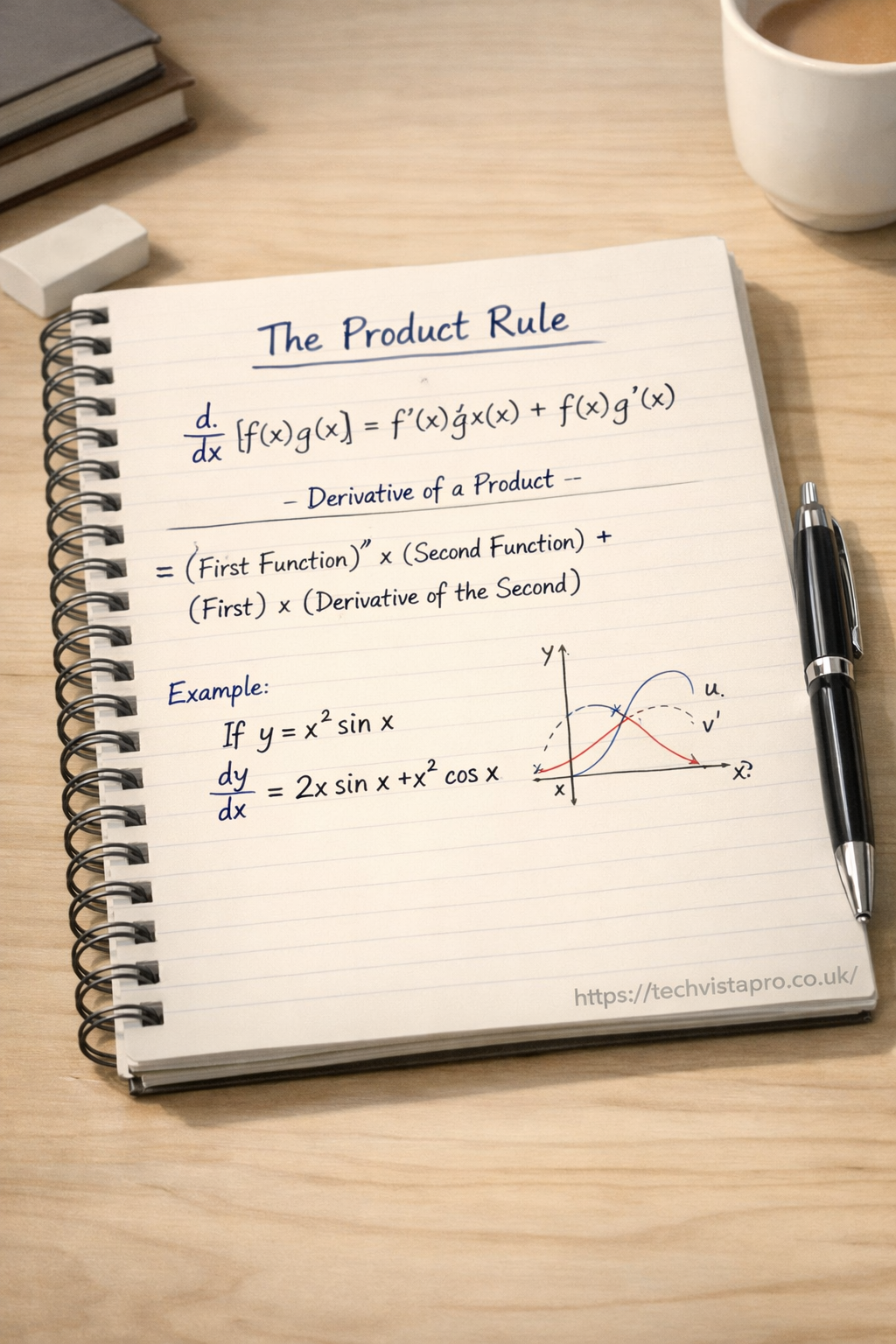
The standard formula of the product rule is written as (fg)’ = f’g + fg’. This means that the derivative of a product is equal to the derivative of the first function multiplied by the second, plus the first function multiplied by the derivative of the second. This symmetrical structure ensures that both functions are treated fairly in the differentiation process.
The logic behind this formula comes from the limit definition of derivatives. When the difference quotient is expanded for a product of functions, additional terms appear that reflect the interaction between changes in both functions. These terms simplify into the product rule formula, which is why it always includes two separate components.
This formula is not just a memorized rule but a mathematically proven identity. It applies to all differentiable functions, whether they are polynomial, trigonometric, exponential, or logarithmic. Its universality makes it one of the most reliable and widely used tools in calculus.
Step-by-Step Understanding of Derivative Process
To apply the product rule effectively, it is important to understand the structured process behind it. When given a function such as y = u(x) · v(x), the first step is to identify both individual functions clearly. This separation helps in organizing the differentiation process correctly.
The second step involves finding the derivative of each function independently. The derivative of the first function is taken while keeping the second unchanged, and then the derivative of the second function is taken while keeping the first unchanged. This dual approach ensures that all possible variations are included.
Finally, both results are combined into a single expression. The derivative of the product becomes u’v + uv’. This final expression represents how both functions contribute to the overall change. The process may seem mechanical at first, but with practice, it becomes a natural part of solving calculus problems.
Intuition Behind Product Rule
The intuition behind the product rule can be understood by thinking about how two changing quantities interact. If one quantity is increasing while the other is also changing, their product does not simply depend on one rate of change but on both simultaneously. This interaction creates a combined effect that the product rule captures.
Imagine two functions representing physical quantities such as speed and time-dependent force. If both are changing, the total effect on the system depends on how each one influences the other at every instant. The product rule reflects this real-time interaction mathematically.
Another way to understand it is by thinking about small changes. When both functions change slightly, the total change in their product includes contributions from each function separately and an overlapping interaction term. The product rule organizes these contributions into a clean and usable formula.
Common Forms and Function Types
The product rule is widely used across different types of mathematical functions, including algebraic, trigonometric, exponential, and logarithmic expressions. For example, when dealing with polynomial functions multiplied by trigonometric functions, the product rule becomes essential for finding derivatives accurately.
In exponential and logarithmic combinations, the rule helps handle expressions such as e^x multiplied by ln(x). These types of functions frequently appear in natural growth models, financial calculations, and scientific equations. Without the product rule, differentiating these expressions would be extremely complex.
Even in more advanced mathematics, such as differential equations, the product rule plays a central role. Many real-world systems are modeled using combinations of multiple function types, and the product rule provides the structure needed to analyze their behavior effectively.
Real-Life Applications in Science and Engineering
The product rule is not limited to theoretical mathematics; it has important applications in real-world disciplines. In physics, it is used to calculate changing quantities such as momentum, energy, and velocity when multiple variables depend on time. These calculations are essential for understanding motion and force systems.
In engineering, the product rule helps in analyzing systems where multiple changing factors interact. For example, electrical engineering uses it in circuit analysis where voltage, current, and resistance may all vary. Mechanical systems also rely on it to model stress, strain, and dynamic motion.
In economics, the product rule is used in analyzing functions where cost, revenue, and production rates interact. It helps economists understand how changes in one variable affect overall economic output. This makes it a valuable tool for decision-making and forecasting.
Connection with Other Calculus Rules
The product rule is closely connected with other differentiation techniques, especially the chain rule and quotient rule. These rules often appear together when solving complex calculus problems. Each rule handles a different type of mathematical structure, but they complement each other in analysis.
When a function involves both multiplication and composition, the product rule is often applied first, followed by the chain rule. This layered approach helps break down complicated expressions into manageable parts, making differentiation more systematic and accurate.
Understanding these connections is important because real-world mathematical models rarely involve simple functions. Most models combine multiple operations, and mastering how these rules interact allows for a deeper understanding of calculus as a whole.
Common Mistakes and Misconceptions
One of the most common mistakes students make is assuming that the derivative of a product is simply the product of derivatives. This misunderstanding leads to incorrect results and shows a lack of understanding of how functions interact in calculus.
Another frequent error is forgetting one part of the formula. The product rule requires both terms to be included, and omitting either u’v or uv’ leads to incomplete answers. This mistake often happens when students rush through calculations without carefully applying each step.
There is also confusion between the product rule and other differentiation rules. Many learners struggle to identify when to use the product rule versus the chain rule. Understanding the structure of the function is essential for choosing the correct method.
Conclusion
The product rule in calculus is a fundamental concept that allows accurate differentiation of functions involving multiplication. It provides a structured method to understand how two changing quantities interact, ensuring that their combined rate of change is calculated correctly. This rule is not only mathematically essential but also deeply connected to real-world applications across science, engineering, and economics
